Showing posts with label Kyauk Kyaw. Show all posts

Thursday, June 17, 2021

Ohno Khawkswe and Kyaukyaw

Ohno Khawkswe

Memorial Day weekend this year brought warmer temperatures, but our nephew and niece from Florida wished they had brought their jackets with them. We celebrated the dawning of a new age, leaving behind the blight of Covid-19 shutdowns and related misery, with Burmese food for lunch. Even though our guests had not tried Burmese food before, they relished their steaming bowls of chicken and coconut noodle soup.

Noodles and Soup

We began by ladling noodles and soup into a bowl and then surveyed the host of garnishes that graced the table. 


With Garnishes

Working our way clockwise in the first picture, we had a choice of fresh lime cut in wedges, roasted and ground chili powder, minced cilantro or fresh coriander leaves, chopped boiled eggs, minced green onions, deep fried onions and deep fried garlic. Not shown in the picture were chili-garlic oil and roasted chickpea powder.

KyauKyaw for Dessert

For dessert we had KyauKyaw (chow-chaw), a cool and refreshing coconut jello that's made with agar-agar or seaweed gelatin.


Friday, September 29, 2017

Burmese KyaukKyaw with Sliced Peaches - Coconut Jello with Peaches

KyaukKyaw with Sliced Peaches
I've spent most of my adult life trying to achieve the perfect Kyauk Kyaw that has two distinct layers, one translucent and the other opaque. Finally the secret was revealed to me when my sister posted a video of it on Facebook. So thanks to Dany Kao for her instructions for a perfect dessert. The secret is to make this with a 1:5.5 ratio of coconut milk to water. I've modified her recipe to include more specific measurements pertaining to the size of cans and amount of agar-agar.

Agar Agar is a popular dessert ingredient in South East Asian countries where it is used as a substitute for gelatin. Agar agar, a seaweed extract, is a good vegan substitute for gelatin which is derived from animal products. Agar agar comes in several different forms - flakes, strands and powdered.  The powdered form of agar agar is much more potent than the flakes or strands. It takes 1 tablespoon of flakes or strands to thicken 1 cup of water, whereas 1 teaspoon of the powder is sufficient to thicken 1 cup of water.

Serve on its own or with canned fruit cocktail or peaches.


Saturday, July 09, 2016

Burmese Kyauk Kyaw - Perfected Technique

Kyauk Kyaw or Coconut Jelly
I've spent most of my adult life trying to achieve the perfect Kyauk Kyaw that has two distinct layers, one translucent and the other opaque. Finally the secret was revealed to me when my sister posted a video of it in Facebook. So thanks to Dany Kao for her instructions for a perfect dessert. The secret is to make this with a 1:5.5 ratio of coconut milk to water. I've modified her recipe to include more specific measurements pertaining to the size of cans and amount of agar-agar.

Agar Agar is a popular dessert ingredient in South East Asian countries where it is used as a substitute for gelatin. Agar agar, a seaweed extract, is a good vegan substitute for gelatin which is derived from animal products. Agar agar comes in several different forms - flakes, strands and powdered.  The powdered form of agar agar is much more potent than the flakes or strands. It takes 1 tablespoon of flakes or strands to thicken 1 cup of water, whereas 1 teaspoon of the powder is sufficient to thicken 1 cup of water.


Thursday, December 10, 2015

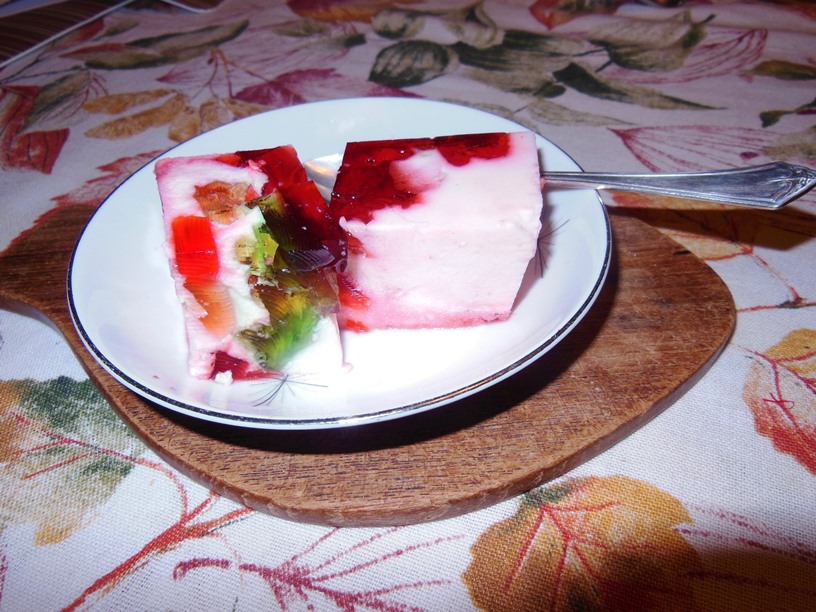
Stained Glass Kyauk Kyaw/Jello

Stained Glass Kyauk Kyaw
Kyauk Kyaw, a popular dessert in Burmese cuisine, is a form of jello made with agar-agar instead of gelatin. Agar agar is a vegetable gelling agent extracted from red algae suitable for vegetarian and vegan diets. I've used the Telephone brand of agar agar powder in this dessert.

Stained Glass Jello Cubes
There are several Stained Glass Jello recipes on the worldwide web made with gelatin and I've been wanting to try it for a while. A potluck for Christmas was the ideal event for this festive dessert. I adapted a traditional recipe to my Burmese tastes by incorporating coconut milk into the recipe. It was a huge success! The neat thing about this dessert is that it can be changed to suit any holiday, simply by switching the colors of jello to suit the occasion. I used green (lime), red (strawberry) and yellow (lemon) packets of jello to represent the Christmas season. The white portion of the jello is the portion that is composed of coconut milk, condensed milk, water and agar agar. This is the kyauk kyaw part of the recipe.

To make this a semi-diabetic-friendly dessert, I used sugar-free Jello gelatin packets to reduce the sugar content which took nothing away from this dessert because the condensed milk is loaded with sugar and overly sweet.